CarbonCast SARIMAX
Time-Series Carbon Intensity Forecasting
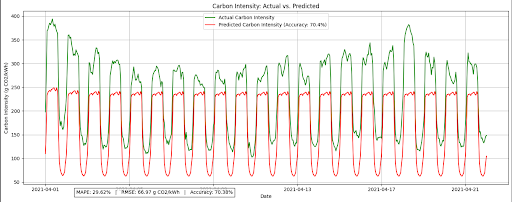
The Objective
I worked under Professor Abel Souza to reduce the carbon emissions generated by all kinds of devices, particularly cloud computing jobs. The existing CarbonCast software utilizes a large LSTM CNN to predict emissions. My research focused on determining if a statistical model could replace this heavy neural network, which would allow the predictive software to be generalized for smaller computing environments like smartphones and smartwatches. I implemented a SARIMAX (Seasonal Auto-Regressive Integrated Moving Average with eXogenous factors) model. This specific statistical model was chosen because it accounts for seasonality, which is critical for modeling the seasonal patterns of renewable energy sources like solar and wind. Instead of relying on neural networks, it uses past values and simple statistics to predict the most likely future carbon intensity.
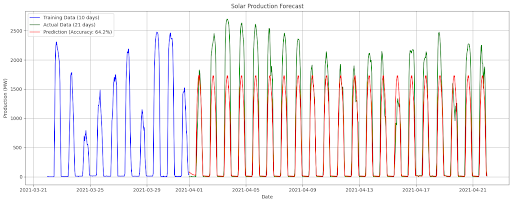
The solar prediction
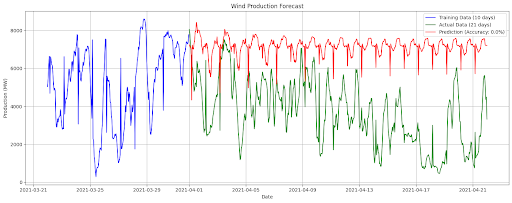
The wind prediction
Predictions & Validation
I evaluated the SARIMAX model against the existing neural network approach using Mean Absolute Percentage Error (MAPE) and visual trend following. Visual trend following was prioritized because our specific use case is primarily concerned with identifying the lowest intensity window, rather than calculating the exact absolute carbon value.
Testing Insights
To find the optimal training times for a given test period, I generated heatmaps to map the error rates across different training and testing day combinations. This testing revealed that a longer training period does not always guarantee more accurate test results, as extending the historical data can introduce noise into the model. Ultimately, the model does not need perfect absolute accuracy to be highly successful for this application. It is entirely possible for the model to have low raw accuracy but high application accuracy, provided the predicted values still correctly identify the optimal time window to execute a heavy compute job.
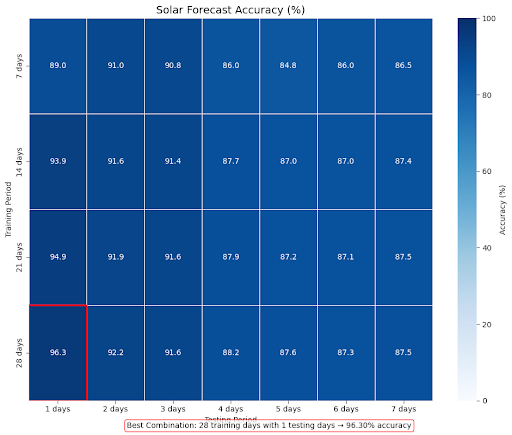
The training process analysis